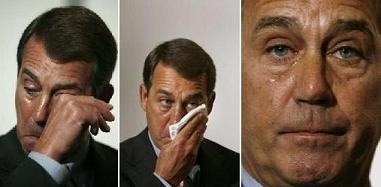
Sunday, January 16, 2011

Paradox


I realize it doesn't entirely make sense, yelling and screaming as I do, about the yelling and screaming. Not entirely. On the other hand, there are times when the only way to be heard in a room of screaming people, is to get up on a chair, beat on a garbage can, and holler: will everyone just shut the f*ck up for a minute!!??

How can I justify my sometimes excessive style of writing here, when it's about excesses of the other side? Well, for one, because I'm pointing out lies and inconsistencies, and I'm pointing out the damage they're doing. Because it drives me crazy that it's become SOP for the GOP. Because I happen to know -- it's not arguable -- that democracy is predicated on thoughtful debate by a well-informed public; and that what passes for thought and information on Fox "news" and in the mouths of the most revered of the RWS™ is exactly the opposite.

When I ask if the overheated rhetoric is a good thing or a bad thing, none of my RW readers choose to answer. When I point out that, sure, there are crazy things said on both sides, but there is simply no equivalent, on the left, to Limbaugh and Hannity and Beck and O'Reilly and Malkin and Ingraham and dozens more, either in substance or scope, no one can refute it. When I point out how absolutely dishonest and inconsistent with even her own utterances is Sarah Palin, how high-school is her world view, people are amazingly easily able to ignore it. Still consider her presidential material. How could I not scream and pull out my few remaining strands of hair?

If seeing a video like the last one I posted isn't enough to make RWS™ and those who love them pause for just a fleeting moment's reflection, take a brief look inward, then what is? Surely it's not sitting down and speaking with our inside voices, is it? Would they even want to? That's neither how they make their millions, or what their millions in listeners want. Or, rather, what they've been taught to want. To their own detriment. Because their hate and shallow thought is a hell of a lot easier than the effort needed to make it all work. In tough times, fairly tales go down easier than truth. Hate and blame are clean and simple; problem solving is not.

As I've made clear here many times, I'm hardly a blind partisan. I've criticized Obama on Afghanistan, health care reform, Gitmo, and caving too quickly on the devastating Bush tax cuts, among other things. But, unlike the RWS™, I don't lie and I don't make stuff up. I don't call for revolution, taking up guns. I don't mischaracterize what's said. Rather, I point out lies, hate, mischaracterizations, and the damage they are doing to our democracy.

How can a person not become enraged about that? If people can be made angry over the patently false, the demonstrably untrue -- Obama born in Kenya, hates America, bent on destroying our very way of life -- then why not over actual dangerous stuff, things that do threaten us, that are true and observable: the RWS™ and those who love them don't believe in democracy (they want their country back after a democratic election, and they came unarmed this time), they are peddling lies (death panels, tax rates, birth certificates) and hate (eliminate liberals, kill Michael Moore [that was Glenn]) and fear (reeducation camps, aiding terrorists), they have degraded education (Texas, creationism as science), they do prefer Soviet-style message control, they do not see those with whom they disagree as "real Americans" (direct quote from you-know-who).

I'd love to be having interesting and challenging discussions about the right level of taxation, which spending cuts make the most sense, the consequences of leaving or staying in Afghanistan. I'd relish hashing out the difference between free speech and hate speech, between tough political argument and rhetorical death matches, in honest recognition of the current atmosphere. Such a discussion, as we've learned lately (as if we didn't know it all along), is simply not possible. Especially when very rich and successful screamers, and the party that loves them, have so much at stake in keeping the climate exactly as it is. No matter the destruction it engenders.

Mainly, though, since I know my words reach only a few ears and that a good percentage of them are hearing-impaired, writing here is just a way for me to deal with, to lessen, the physical and very real tension I feel when I read the day's news, read of the latest outrageous thing said by those considered oracles by our fellow citizens of the right wing variety.

Other than the occasional letter to the editor, giving to people and causes in which I believe, the rare attendance at a caucus, it's all I've got.

Against the red tide, it ain't enough.


Saturday, January 15, 2011

Simple


Nothing like fear of death to clarify one's thinking.

On gun control, Peter King, hard-core Republican Congressman and teabagger favorite, sticks his neck out.

Rep. Peter King, a Republican from New York, is planning to introduce legislation that would make it illegal to bring a gun within 1,000 feet of a government official, according to a person familiar with the congressman's intentions.

King is chairman of the House Homeland Security Committee.


I'm sure he'll get flack for it. But here's my question: if it's okay for the people's elected representatives, why not for the people who elected them? Are congressional lives specialer than mine? Teabaggers, after all, are for the common people, right, not those Washington elites. So why not expand the law to include you and me? (Well, yeah, they rejected the idea of giving us the health care privileges of Congress, so I guess they're okay with letting the rest of us get shot. It's a health thing...)

It's pretty simple, really. No need to outlaw guns. Just go with Peter King and make it illegal to bring a gun within 1000 feet of anyone, not just government officials. In fact, although I don't know the strict definition of "officials," it might go without specifying, given the number of people around the country on government payrolls. And we can give everyone really long tape measures.

If it's good for them, it's good for us. I'm liking it. A thousand feet. Brilliant -- and from a Republican.

Friday, January 14, 2011

No-Fault Assurance


It was a tea party mob. Their chosen candidate stood by. Hate was palpable. Subsequent comments were even worse. But, no, no responsibility there. Bringing up political hate is "divisive," it's "politicizing tragedy." Even to ask the question or to want to have a clear-headed discussion.

Contrast the Congressman's words to those used against him.

Incidentally, here's (in a comment thread) some rich (and satisfying) irony:

Does anyone else see the irony in this tragedy? In Arizona, the state that has been the de facto "face" of recent political gay bashing (DADT-McCain) and Racism (their highly controversial immigration law), a white straight man shoots a member of congress who then has her life saved by a gay Hispanic American. It's poetic.

Thursday, January 13, 2011

Pawlenty Of Trouble


Without paying enough attention, evidently, I'd been of the impression that, among potential Republican presidential candidates, Tim Pawlenty was one of the more reasonable. Guess I was wrong. (I'm still having problems embedding Daily Show videos, but it's at the link.)

Now, I'll say this: Jon Stewart, of late, has seemed a little too talky on his side of his questions. Nevertheless, his point wasn't impossible to apprehend: are we really heading toward "tyranny" since the election of Barack Obama; and how is it different from the reign of George Bush? (Arresting US citizens without charges, holding them incommunicado, warrantless wiretapping, undeclared wars, taking over education. Stuff like that.) Try as he might, Stewart couldn't get Pawlenty to admit it might be a bit overstated; in fact, the ex-gov seemed unwilling even to address the question. He preferred the current "I know you are but what am I" approach to the issue. (The tax/spend discussion was a little more reasonable, but, again, he steadfastly refused to consider what pretty much everyone else recognizes: ultimately, the deficit will only be solved by a combination of increased revenue and decreased spending, including defense. That, at least, is standard right-handed stuff. But his unwillingness to reject claims of tyranny says a lot. None of it good.)

Having been thus disappointed by the interview (well, not disappointed, really: brought back to reality -- there are no R candidates who wish to appear reasonable at all, lest the teabaggers undip them) this morning I read the guy wants to reinstate DADT. (And let's not ignore to whom Timmeh chose to make his pronouncement.)

After the president's speech last night I've thought I must be a little less, uh, colorful in some of my writings. But it's not inflammatory simply to point to the truth about people. (Well, yes, the hearing of truth seems to inflame some readers, but there's nothing I can do about that.) The fact is that, on the right, teabaggerism -- ie the need to believe the worst about the president, the need to lash out, the need to cling to discredited policy -- has won the day in the current Republican party and its potential candidates. The guy I mistakenly took for thoughtful at one time can't find it in himself to agree we're not heading toward tyranny just because a president wants to make health care more accessible.

Tyranny. Nope, can't deny it. Can't demonstrate it, can't differentiate it from what went on under the previous president. Can't deny it, though. Wouldn't fly. Not now, not with the RWS™ and the teabaggers pulling the strings and calling the shots. (Oops. There I go, using violent rhetoric.)
____________________

Added: true to formless, he's now hit the elitist button.


The President


.... You see, when a tragedy like this strikes, it is part of our nature to demand explanations - to try to impose some order on the chaos, and make sense out of that which seems senseless. Already we've seen a national conversation commence, not only about the motivations behind these killings, but about everything from the merits of gun safety laws to the adequacy of our mental health systems. Much of this process, of debating what might be done to prevent such tragedies in the future, is an essential ingredient in our exercise of self-government.


But at a time when our discourse has become so sharply polarized - at a time when we are far too eager to lay the blame for all that ails the world at the feet of those who think differently than we do - it's important for us to pause for a moment and make sure that we are talking with each other in a way that heals, not a way that wounds.


Scripture tells us that there is evil in the world, and that terrible things happen for reasons that defy human understanding. In the words of Job, "when I looked for light, then came darkness." Bad things happen, and we must guard against simple explanations in the aftermath.


For the truth is that none of us can know exactly what triggered this vicious attack. None of us can know with any certainty what might have stopped those shots from being fired, or what thoughts lurked in the inner recesses of a violent man's mind.


So yes, we must examine all the facts behind this tragedy. We cannot and will not be passive in the face of such violence. We should be willing to challenge old assumptions in order to lessen the prospects of violence in the future.


But what we can't do is use this tragedy as one more occasion to turn on one another. As we discuss these issues, let each of us do so with a good dose of humility. Rather than pointing fingers or assigning blame, let us use this occasion to expand our moral imaginations, to listen to each other more carefully, to sharpen our instincts for empathy, and remind ourselves of all the ways our hopes and dreams are bound together.


After all, that's what most of us do when we lose someone in our family - especially if the loss is unexpected. We're shaken from our routines, and forced to look inward. We reflect on the past. Did we spend enough time with an aging parent, we wonder. Did we express our gratitude for all the sacrifices they made for us? Did we tell a spouse just how desperately we loved them, not just once in awhile but every single day?


So sudden loss causes us to look backward - but it also forces us to look forward, to reflect on the present and the future, on the manner in which we live our lives and nurture our relationships with those who are still with us. We may ask ourselves if we've shown enough kindness and generosity and compassion to the people in our lives. Perhaps we question whether we are doing right by our children, or our community, and whether our priorities are in order. We recognize our own mortality, and are reminded that in the fleeting time we have on this earth, what matters is not wealth, or status, or power, or fame - but rather, how well we have loved, and what small part we have played in bettering the lives of others.


That process of reflection, of making sure we align our values with our actions - that, I believe, is what a tragedy like this requires. For those who were harmed, those who were killed - they are part of our family, an American family 300 million strong. We may not have known them personally, but we surely see ourselves in them. In George and Dot, in Dorwan and Mavy, we sense the abiding love we have for our own husbands, our own wives, our own life partners. Phyllis - she's our mom or grandma; Gabe our brother or son. In Judge Roll, we recognize not only a man who prized his family and doing his job well, but also a man who embodied America's fidelity to the law. In Gabby, we see a reflection of our public spiritedness, that desire to participate in that sometimes frustrating, sometimes contentious, but always necessary and never-ending process to form a more perfect union.


And in Christina we see all of our children. So curious, so trusting, so energetic and full of magic.


So deserving of our love.


And so deserving of our good example. If this tragedy prompts reflection and debate, as it should, let's make sure it's worthy of those we have lost. Let's make sure it's not on the usual plane of politics and point scoring and pettiness that drifts away with the next news cycle.


The loss of these wonderful people should make every one of us strive to be better in our private lives - to be better friends and neighbors, co-workers and parents. And if, as has been discussed in recent days, their deaths help usher in more civility in our public discourse, let's remember that it is not because a simple lack of civility caused this tragedy, but rather because only a more civil and honest public discourse can help us face up to our challenges as a nation, in a way that would make them proud. It should be because we want to live up to the example of public servants like John Roll and Gabby Giffords, who knew first and foremost that we are all Americans, and that we can question each other's ideas without questioning each other's love of country, and that our task, working together, is to constantly widen the circle of our concern so that we bequeath the American dream to future generations.


I believe we can be better. Those who died here, those who saved lives here - they help me believe. We may not be able to stop all evil in the world, but I know that how we treat one another is entirely up to us. I believe that for all our imperfections, we are full of decency and goodness, and that the forces that divide us are not as strong as those that unite us.


That's what I believe, in part because that's what a child like Christina Taylor Green believed. Imagine: here was a young girl who was just becoming aware of our democracy; just beginning to understand the obligations of citizenship; just starting to glimpse the fact that someday she too might play a part in shaping her nation's future. She had been elected to her student council; she saw public service as something exciting, something hopeful. She was off to meet her congresswoman, someone she was sure was good and important and might be a role model. She saw all this through the eyes of a child, undimmed by the cynicism or vitriol that we adults all too often just take for granted.


I want us to live up to her expectations. I want our democracy to be as good as she imagined it. All of us - we should do everything we can to make sure this country lives up to our children's expectations.


Christina was given to us on September 11th, 2001, one of 50 babies born that day to be pictured in a book called "Faces of Hope." On either side of her photo in that book were simple wishes for a child's life. "I hope you help those in need," read one. "I hope you know all of the words to the National Anthem and sing it with your hand over your heart. I hope you jump in rain puddles."


If there are rain puddles in heaven, Christina is jumping in them today. And here on Earth, we place our hands over our hearts, and commit ourselves as Americans to forging a country that is forever worthy of her gentle, happy spirit.


May God bless and keep those we've lost in restful and eternal peace. May He love and watch over the survivors. And may He bless the United States of America.

Well done, Sir.

Wednesday, January 12, 2011

The Definition Of Incoherent


From Andrew Sullivan, a selection of reactions to Sarah Palin's video.

How about this for logic:

1. "Acts of monstrous criminality stand on their own. They begin and end with the criminals who commit them."

2. "Especially within hours of a tragedy unfolding, journalists and pundits should not manufacture a blood libel that serves only to incite the very hatred and violence they purport to condemn."

In the first statement, she is saying that you can't incite people to violence, they stand on their own. The second statement, however, makes the opposite claim (that you can incite people to violence).

If crimes "begin and end with the criminals who commit them," I think Sarah Palin just endorsed a mosque near Ground Zero.

In addition to the inconsistency of Palin's blood libel accusation, there is this to be considered. If associating her violent political rhetoric tangentially with the Arizona shooting is a "blood libel" (accusing her of something heinous to incite violence against her), then why is her unfounded accusation of "death panels" against liberals not one as well? I think she has finally stepped into the quicksand and doesn't have the self-restraint to avoid flailing.


"Today has been set aside to honor the victims of the Tucson massacre. And Sarah Palin has apparently decided she's one of them," - Josh Marshall.


Palin simply can't help it. You know that friend of yours for whom everything is always about them? Your dad is in the hospital and your cat just died and you lost your job, and yet she blows up at you because you forgot her birthday? Palin is that friend.


Not entirely unrelated: in regards to Roger Ailes' (head of Fox "news") statement that he "told all of our guys, shut up, tone it down, make your argument intellectually. You don’t have to do it with bombast. I hope the other side does that," it's been pointed out that

"...there is so much going on in that single comment that undermines a lot of what he's intending to accomplish. The most notable is that by stating "the other side" he's explicitly admitting that his entire network is on the side of Palin/GOP and the right in general. Further: "Democrat Party"?? Forgive me if I find Ailes' call for sanity to be a little weak and disingenuous."

Another writes:

"Other side"? It’s telling that even the CEO doesn’t try to maintain the pretense of fairness and balance, his channel’s trademark.


Sigh. Sarah Palin and Fox "news." Idiocy with a megaphone.

Reflection


I keep thinking about the murders, and the reactions to them.

To me, it's undeniable that there's far more hateful and eliminationist rhetoric pouring from the right than the left. The examples of left-wing excesses are, nearly exclusively, the utterances of some individual in a blog comment, or the occasional hateful sign or shout at a rally. And it's exceptional. From the right, it's a constant, both in the halls of Congress and in their admitted and self-described propaganda wing known as Fox "news." It's the game plan.

People who call for killings -- Ann Coulter, for example -- are regularly seen and lionized on Fox "news." And their own commentators -- Sean Hannity for example -- announce we'd be better off if all liberals were eliminated. Rush Limbaugh makes millions and has millions of listeners because he rants endlessly about the evil of the other side; vomits up unapologetically racist bile. When Keith Olbermann goes over the top, he gets called out. And apologizes. Changes his show. Bill O'Reilly gets pissed. (Not to mention defensive.) Pretends he's mild as milk. Glenn Beck goes into denial mode.

People claim such rhetoric is behind the killings, others deny it. Democrats propose civility, Republicans say no.

But let's let all of that go for a minute. Most likely, that direction leads nowhere. Let's just ask a basic question: whether or not it had anything to do with this particular horror, is it a good thing or a bad thing for a democracy when parties (I'll say it in the plural, but you know where I stand) literally demonize their opponents? If democracy is founded on -- depends on -- thoughtful discourse, careful deliberation and, yes, compromise, is it better or worse for the process if people are made to hate those with whom they disagree; to be told those people literally want to destroy them?

Are issues better addressed factually, honestly, recognizing differences of opinion as valid and worthy of consideration; or is it better to demand no compromise, to believe that the giving of an inch is a step toward destruction by literally evil forces? Is one more consistent with democracy, the other with totalitarianism?

In short: whether or not Sarah Palin's gunsights, Sharon Angle's "second amendment remedies," Michelle Bachman's "armed and dangerous," Glenn Beck's concentration camps and "deep seated hatred of white people," Sean Hannity's "eliminated," Ms Gifford's opponent's M-16 rally, had anything to do with this particular shooter's motivations: is such talk a good thing or a bad thing for the future of the American democracy?

In microcosm, I ask again: is a crazy person more likely to do harm if he's constantly being told there are enemies all around, or if he's told we're all on the same team? In the larger sense, I ask: if democracy is a valid form of government in a pluralistic society, is it better served by honest and level-headed debate of its most difficult problems, or will its survival be more assured by propagandizing, lying, and demonization of opposing views?

It's a simple question; forget about Arizona: Are the screamers helping, or hurting?

To me, the answer is obvious.

But then, I actually believe in democracy.
____________________________

Added: datum to help in the discussion.


Tuesday, January 11, 2011

Reality's A Bitch


This isn't just about hypocrisy, or death panels, or Jan Brewer, but that's where the discussion has to start:
“How many people have to die before you are prepared to reverse your decision on the transplant operations?” seemed like the obvious question.

She said she thought that was unfair and started to explain how dire the state’s financial situation is. If people are so worried about the transplant patients then they should ask the federal government in Washington to send us more money, she said.But she would not explain to me, or to any Democrats in the state capitol, what she has done with the nearly $200 million she was already given in ‘stimulus funds’ to spend on anything she liked.


Cut federal government spending/give us more federal money. Repeal health care/give us the money in the health care bill. End Obamacare because it's rationing/ration medical care to save money.

Sure, it's hypocrisy of the first order. Of course, it's completely dishonest and untenable. That much goes without saying. Or, rather, it's what I, along with everyone else with more than two neurons to rub together, have been saying: teabaggerism (ie, Reaganomics) simply doesn't work; can't work. Has never worked.

The larger point, though, is how tough it really is. The times are tough, the solutions -- if any -- are tough. It's easy to laugh (and I do) or cry (and I do) at people like Jan Brewer; but the fact is she's fighting the same battle as everyone else. She -- like the teabaggers of which she's a prime example -- simply has an empty quiver.

But she is a real-world example of what happens when you apply too-easy answers to too-hard problems. Naive, she may be. Crazy. In over her head. But she's just doing what a hell of a lot of people do when the going gets tough. Go into tilt mode. Resort to magical thinking. Sadly, it's human.

Probably because we weren't intelligently designed.

There's just no way to get from here (badness) to there (wonderfulness) without doing some really hard, really unpleasant things, really controversial things. Things that will require compromise, facing facts, admitting that there's no magic; in short, things that seem as far from teabagging Republicanism (as opposed to the kind that was around a generation ago: thoughtful, in a word) as Glenn Beck is from planet Earth.

Nor are Democrats above criticism: the idea of "belt-tightening," as in correlating social programs with need, raises screams from the extremes. As opposed to the Rs, however, they do recognize the needs we face and that they'll have to be paid for. That tax cuts aren't magic mushrooms.

So Jan Brewer is a microcosm. Sadly, she represents far too many of us -- enough that, looking below the surface of folly, it seems literally impossible that we're any longer equipped as a nation to do what needs doing. And pardon me for saying so, but I see it as of a piece with our (Foxoreillian cries of anti-christianism notwithstanding) ever-increasing national religiosity. Religious thinking (ie, relying on the unprovable, the not reality-based, believing whatever it takes to feel safe in a dangerous world) is fine when confronting the unknowable, like death. There, other than being the basis for wars and mass killings, for discrimination and hatred, it works well. But when the problems are in the now, and require workable solutions in real time, before the end times, it lacks a certain, well, functionality.

Teabaggerism is not just like religion. It is religion. The problem is that, with religion, whether one is right or wrong won't be determined in this world. With teabaggerism, with Reaganomics, it's already known. And Jan Brewer's dilemma shows it, as clearly as a mushroom cloud.

Saddest of all, when confronted with the impossibility, the response is to dig in deeper.

And this kind of crap hardly suggests any impending breakthroughs.

Monday, January 10, 2011

It's Crazy


Paranoid schizophrenia has intrigued me ever since my psych rotation in med school. Talking with affected young adults, hearing their crazy theories, I couldn't help but think -- they all seemed exceptionally intelligent on some level -- that their insanity came about because, for some brief moment of clarity, they'd seen things as they really are, and it blew their minds. It made me think that we all need patches to the holes that appear in the curtain, lest we see behind it. Glenn Beck, Religion, Reaganomics, Glenn Beck, teabaggerism, Glenn Beck, talk radio, Glenn Beck...

There's a word for those of us who try hard to keep our eyes open and our minds unclouded: depressed.

(It happens that, at the same time in med school, I was reading L. Ron Hubbard's book, Dianetics, and it sounded exactly like the stuff pouring out of schizophrenic brains. In Elron's case, however, I'm guessing it was a deliberate con job.)

Be that as it may, it's interesting that the beliefs of those so affected seem (from what little I know of it) to follow such similar patterns: belief in mind control, implanted devices, hearing voices; seeing dire patterns where there are none, conspiracies, plots, hidden signs. Commonly, too, there's a religious undercurrent, and I find that of interest as well: in what ways does the mumbler on the street corner, the passer-out of rambling and capitalized literature past whom we hurry with downturned eyes, differ from others whose claims took hold? Jim Jones, David Koresh, Joseph Smith... Luck? Off by a couple of phrases from connecting with the extant level of illness of those around them?

Anyway, here's the thing: we generally accept that the paranoid schizophrenic has a determinable disorder of the brain. Chemical, in some way. Anatomic perhaps. And, given that most -- if not all -- human disorders have a spectrum of expression, might it also be the case that the most recalcitrant political conspiracists among us are similarly dyschemified-- just a bit less, to varying degrees?

Is birtherism in the face of all the evidence, for example, not a certifiable condition of a disordered mind? What about climate-change denial? And it's really hard, impossible in my view, to reconcile young-earthism with any sort of rational thinking at all. So maybe it's not their fault: they're just a little further toward the far end of that chemical line than others of us, led around by different molecules. The more I think about it, the less the word "sane" has any meaning. There is no "sane"; probably no "line" either. Just points on a circle.

This is relevant in instances of political murder. The guy who shot the Congresswoman and killed a child, among others, seems to be a schizophrenic, all right. Predictably, people like me find a connection with incessant right-wing hate speech; while the purveyors of that speech, and those who love to listen to it, immediately crank up their who-me. As George Packer wrote yesterday:


.... It would be a kind of relief if Loughner operated not out of any coherent political context but just his own fevered brain.

But even so, the tragedy wouldn't change this basic fact: for the past two years, many conservative leaders, activists, and media figures have made a habit of trying to delegitimize their political opponents. Not just arguing against their opponents, but doing everything possible to turn them into enemies of the country and cast them out beyond the pale. Instead of “soft on defense,” one routinely hears the words “treason” and “traitor.” The President isn't a big-government liberal—he's a socialist who wants to impose tyranny. He's also, according to a minority of Republicans, including elected officials, an impostor. Even the reading of the Constitution on the first day of the 112th Congress was conceived as an assault on the legitimacy of the Democratic Administration and Congress.

This relentlessly hostile rhetoric has become standard issue on the right. (On the left it appears in anonymous comment threads, not congressional speeches and national T.V. programs.) And it has gone almost entirely uncriticized by Republican leaders. Partisan media encourages it, while the mainstream media finds it titillating and airs it, often without comment, so that the gradual effect is to desensitize even people to whom the rhetoric is repellent...


(Interestingly, one Republican senator has spoken out about the rhetoric. But he felt the need to do so anonymously.)

My point, at long last, is this: people spew political hate because it works. Witness teabaggers, beguiled and bamboozled by Glenn Beck and Sarah Palin. It works, in large part, I'd argue, because of the fallibility of the human mind (poorly designed as it seems to be.) Some people can deal with honest discourse, others can't. Some can accept people with whom they disagree without the need to demonize, to destroy them, others can't. And if I'm right -- that there's a spectrum, that paranoid schizophrenia is but a point on a nomogram -- then people like the RWS™ and those who enable and excuse them simply can't have it both ways. They can't gloat at the successes of their hateful and conspiratorial speech and, at the same time, deny it has an effect.

The guy is crazy, they say. It's not my fault. Don't expect me to change my tone, they announce. I'm not responsible for how people react to it.

Really? Does that make any sense at all? Believing your words have power over people, and denying it at the same time?

If we know there are crazy people out there -- especially if, in fact, sanity and its opposite are like height and weight and skin color and musical ability, spread among us: we're all crazy -- isn't it incumbent on those who have the greatest audience to take a little care, to show at least a modicum of restraint? Can they claim power and pretend it doesn't have any effect? On humans, in all their frailties? Might they consider it useful -- moral and ethical, even, if such things had meaning to them (evidence lacking) -- to find a less hateful, less apocalyptic way to make their point? Is that all they've got? Or, worse, is this kind of result they actually want? Elimination of liberals? Explicitly? Because that's what they're saying. Notwithstanding their self-righteous and deeply offended protestations to the contrary, how does that deserve a pass? Can they claim they don't know their audience, when they fine-tune their message to the crazy channel? Reload. Eliminate. Take them out. They mean to destroy you. Reëducation camps. Become "armed and dangerous." No effect? No responsibility? None and none?

Would you walk through a room full of the immuno-deficient if you were coughing up mycobacteria? Wouldn't you at least put on a goddamn mask???

If you smoke in a room full of straw men, are you absolved of the fire?

Saturday, January 8, 2011

Just A Coincidence


Texas Hold-Em (Up)


A conservative friend recently touted Texas as a great place to live: low taxes, low unemployment, none of the budget problems facing places like California, on a roll. Sounded good. Until I read this.

These are tough times for state governments. Huge deficits loom almost everywhere, from California to New York, from New Jersey to Texas.

Wait — Texas? Wasn’t Texas supposed to be thriving even as the rest of America suffered? Didn’t its governor declare, during his re-election campaign, that “we have billions in surplus”? Yes, it was, and yes, he did. But reality has now intruded, in the form of a deficit expected to run as high as $25 billion over the next two years...

...The only thing that let Gov. Rick Perry get away, temporarily, with claims of a surplus was the fact that Texas enacts budgets only once every two years, and the last budget was put in place before the depth of the economic downturn was clear. Now the next budget must be passed — and Texas may have a $25 billion hole to fill.

And that reality has implications for the nation as a whole. For Texas is where the modern conservative theory of budgeting — the belief that you should never raise taxes under any circumstances, that you can always balance the budget by cutting wasteful spending — has been implemented most completely. If the theory can’t make it there, it can’t make it anywhere.

How bad is the Texas deficit? Comparing budget crises among states is tricky, for technical reasons. Still, data from the Center on Budget and Policy Priorities suggest that the Texas budget gap is worse than New York’s, about as bad as California’s, but not quite up to New Jersey levels.


It reminds me of the much touted (by GW Bush) "Texas Miracle" of public education. Amazing test scores, found to be quite literally fraudulent, as it was discovered that the Houston education supe, whom Bush appointed Education Sec, was booting out struggling kids before they had a chance to take the tests.

Frankly, given the dire straits in which my state and most others find themselves, the idea that any state, even the venal Texas, might have found a formula that works was -- swallowing hard -- encouraging. Well, maybe not that. After all, they're leading the nation in politicizing and Jesufying education. Still, any state that can maintain solvency in these times deserves a look.

So much for that.

It's a myth: if tax cuts and spending cuts is all you gots, failure is what you'll get, sooner or later.

Bruce Bartlett, Reagan's economist and a serious guy, says:

The reality is that Social Security, Medicare and Medicaid are where the real money is, and reducing outlays for these programs is very, very hard; not just for political reasons, but because they are highly complex programs and require changes in the law governing eligibility to reduce spending in the long run. Doing so in a way that can’t be gamed by beneficiaries or create massive unfairness is a major challenge.

Congress needs the best possible analysis and research to help it understand the nature of the programs it wants to cut and how to write laws that will achieve its goal. Fortunately, it already has an organization at its disposal called the Congressional Budget Office to do this. Established in 1974, it has 250 of the best budget analysts and economists in Washington and deep institutional knowledge of every facet of government spending. (A parallel organization called the Joint Committee on Taxation does the same thing for tax policy.)


Funny thing, that last paragraph: Rs like the CBO when it says what they want to hear. When not, they do what they always do when facts don't fit their fantasies: they ignore it. (Or lie about it.) Which is exactly why the crap up with which they always come never works. And why they don't care.

Or even notice, evidently.


Friday, January 7, 2011

War Zone


I've said it before (no links, sipping gin): Robert Gates impresses me. He, alone among Republicans, is willing to address reducing defense spending. His latest announcement, and the response thereto, is as revelatory as it is predictable. His plan is hardly a huge shift in the paradigm; disturbance in the force, if any, is minimal.

WASHINGTON – For the first time in more than a decade defined by costly wars in Afghanistan and Iraq, the Pentagon announced plans Thursday to freeze its ballooning budget, forcing the services to shrink the Army and Marines and increase health care premiums for military retirees and their families.

The Pentagon says it can stop asking for annual budget increases in 2015, adjusting its spending only for inflation. The last time the Pentagon's budget went down was in 1998...

... Although it took Gates more than 30 minutes to read an explanation of the reductions, he called the proposals modest and realistic.

This, of course, gives Republicans the vapors. Right on cue, they lashed out at our terrorist-loving president:

Almost immediately the proposal ran into opposition in Congress, including Republicans who say President Barack Obama is short-changing the military.

"I'm not happy," said Rep. Buck McKeon, who as chairman of the House Armed Services Committee helps oversee the military budget.

"This is a dramatic shift for a nation at war and a dangerous signal from the commander-in-chief," McKeon, R-Calif., added.


(That's from the guy who sees the war in Afghanistan as fulfilling Mormon prophesy.)

Nor were Democrats uniformly on board. There's money in that there budget:
"I'm willing to work with Secretary Gates and the president to cut wasteful defense spending, but cutting the budget on the backs of Ohio's workers is unacceptable," said Sen. Sherrod Brown, D-Ohio

Hope? None. Political courage? In the White House, maybe. Public support? Dip me in hot water and call me Earl Grey.
________________________

P.S.: Here's another reason to admire Gates.

Dishonesty On Display


We've known for a while now that House Republican claims of fiscal seriousness is crap. In particular, they've announced that any deficits that accrue from their planned tax cuts don't need to be offset. Deficits from tax cuts don't count; only those from spending do. It's Teabagger Econ 101. If anyone can bend that one around the idea of budgetary seriousness, please show me how.

On a roll of illogic, they've gone even further. Were they to succeed in repealing health care reform, with its projected hundreds of billions in savings, that doesn't count either. Doesn't need to be balanced in some way.
GOP RULES EXEMPT COSTS OF REPEALING HEALTH CARE - House Republican rules for the 112th Congress exempt all sorts of tax cuts from any requirement that their deficit impact be offset -- including one they jarringly refer to as the "estate tax" (the wha??) -- but they specifically "exempt the budgetary effects of legislation repealing the Patient Protection and Affordable Care Act and the Health Care and Education Affordability Reconciliation Act of 2010."

Wonder what the difference is. Are tax-cut deficits made of something different from spending ones? Smoke? Cotton candy? Congressional Republicans assume their supporters are idiots. Will they ever be proved wrong? This is me, not holding my breath.

Meanwhile, in another of what has been and will continue to be an endless string of hypocritical reversals, the newly-powerful house Rs plan to use a legislative trick about which they screamed like scalded eagles when the Ds considered using it (and then, of course, backed down.)

This week, House Republicans will resurrect an arcane tool that will give its Budget Chairman temporary, but unilateral authority to set federal spending levels for part of this year.

Welcome back to the so-called "Demon Pass", which is scheduled to make its return to the Capitol Hill on January 5.

Because Democrats didn't pass a budget, and because spending authority expires in early March, there's a strong chance that the government will run out of money before the House and Senate agree to new spending levels. When that happens, under the new House rules, spending will continue -- but at levels no higher than those chosen by the House Budget Committee chairman, Paul Ryan.

As soon as those rules are adopted on Wednesday, Ryan's spending levels will be considered -- or "deemed" -- adopted by the full House as if they'd passed a budget with a floor vote. The legislative language in the rules package holds that Ryan's spending limits, "shall be considered as contained in a concurrent resolution on the budget for fiscal year 2011 and the submission thereof into the Congressional Record shall be considered as the completion of congressional action on a concurrent resolution on the budget for fiscal year 2011."...

...This quickly became known as "Demon Pass," or the "Slaughter Solution," named after House Rules Chair Louise Slaughter....

...Republicans rebelled, and conservatives went off the deep end. Radio talk show host Mark Levin called it "100 times worse than Watergate."

Democrats eventually bowed to that pressure and decide not to use the process -- known technically as "deeming," or a "self-executing."

In reality, deeming is used fairly frequently by both parties, but not typically on such high-profile issues. Democrats used it in lieu of passing a budget resolution last year -- a move the GOP similarly opposed.

Were I to try to document each and every instance of Rs doing exactly the opposite of what they promised, I'd have no time for anything else; they've barely taken over the House, and the list is endless. (Remember when they claimed bills were shoved down their throats without the ability to offer amendments? Never happened.)

It's gonna be some year.


Thursday, January 6, 2011

Dick Is Done


Dick Lugar, R-Sanity, will get the axe as surely as John Boehner cries and Sarah Palin lies. He's been the closest thing to reasonable among Republicans in Congress for a long time, but now he's crossed a line.

WASHINGTON -- Sen. Richard Lugar (R-Ind.), increasingly a voice of reason and moderation within his own GOP, gave President Obama credit on Sunday for reaching out to Republicans, breaking with the party-line criticisms that the administration is not listening at all to the opposition. He also warned his colleagues against becoming the "party of no," saying that voters will start to hold Republicans accountable if they don't offer actual solutions.
Bucking his leadership, putting country first (remember that?), he's even come out in support of START.

Taking up arms, leaving their spell-checkers and punctuation behind, the resistance is rising:

There has been a lot of discusion about Dick Lugar, and I would say most is not good. Most feel, Lugar needs to leave, but fanuary 2013 is a long way off. We need to satart a Petition, asking Senator Lugar to consider, early Retirement. He has gone left of Center,and made himself available for a Campaign add to help Obama secure the Presidency. That alome was reason enough for his early departure. He has cros ed the line in Conservative Politics, and become a Rino, dreaded to all Conservative's everwhere.

The race to be rid of him has begun. His sad attempts to show his conservative bona fides to the teabaggers ain't working. Because the last thing this country needs is a sensible conservative, interested in ideas and collaboration. If we had problems to solve, maybe, yeah. But things are just fine; or they will be, once they take us back to Ronald Reagan and Jesus Christ. (In that order: first things first.)


More Of A Guideline Than A Rule...


That was quick. I can still hear Boner's gavel.


WASHINGTON — Many people knowledgeable about the federal budget said House Republicans could not keep their campaign promise to cut $100 billion from domestic spending in a single year. Now it appears that Republicans agree...

... Now aides say that the $100 billion figure was hypothetical, and that the objective is to get annual spending for programs other than those for the military, veterans and domestic security back to the levels of 2008, before Democrats approved stimulus spending to end the recession.

Yet “A Pledge to America,” the manifesto House Republicans published last September, included the promise, “We will roll back government spending to pre-stimulus, pre-bailout levels, saving us at least $100 billion in the first year alone.”


Really, how can there be an argument: these are the most dishonest guys ever to darken the halls, and they got where they are by deliberate deception, counting on the bottomless gullibility of their voters.

Teabaggers.

Was there ever a group so thoroughly, so predictably, so obviously -- and so willingly -- deceived?

And before the naysayers (most of whom seem to have slunk off from here, unable to deal with having their bullshit called out) say it: nope, not Obamaphiles. Not even close. He's made good on most of his promises, and where he hasn't, it's not been for lack of trying. But these guys? They never meant a damn thing they said; never intended to do any of it. They've always known it was impossible. Why? Because it's failed every single time starting with Ronnie the Wonderful. Seeing opportunity, they lied their way in on the skids provided by teabaggers, financed by the super-wealthy, and trumpeted non-stop by Fox "news" and the rest of the RWS™.

It was never serious, other than maintaining tax cuts for the rich and the corporate, and calling it good for everyone else. What's so amazing is that, in office for only a day, they haven't even pretended otherwise.

Popular posts